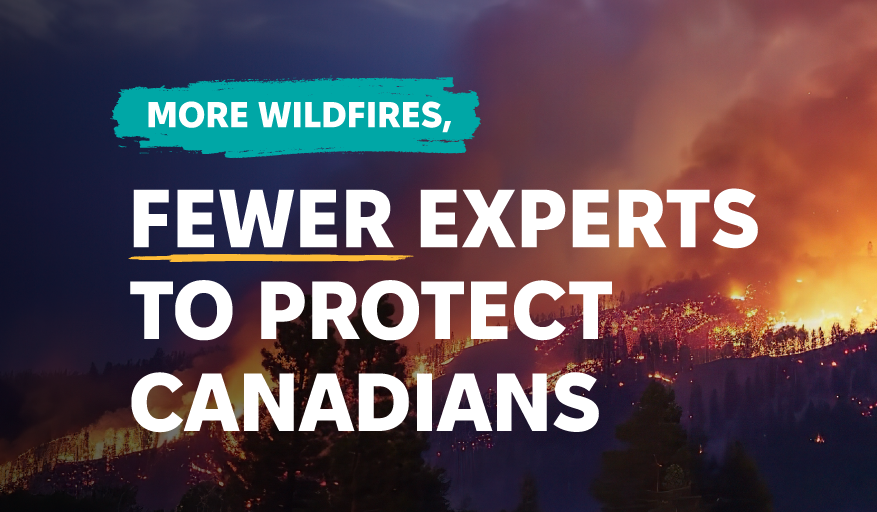
Ottawa (ONTARIO), July 15, 2026 – On July 9th the federal government provided an update on the worsening wildfire situation across the country, and promised to act with urgency to protect Canadians. Yet at the same time, it is cutting the public scientists and technical experts whose work makes wildfire prevention and preparedness possible.
“The government is warning Canadians that the wildfire threat is growing while cutting the experts who help us understand, anticipate and prepare for that threat,” says PIPSC Vice-President Stéphanie Fréchette. “That is not responsible planning; it is a hasty, short-sighted decision that will leave communities less prepared.”
Public scientists at the Canada Centre for Mapping and Earth Observation produce wildfire and disaster mapping used by governments and emergency responders. Experts at the Canadian Forest Service study changing fire risks and help communities adapt to a warmer, drier climate. The Canadian Forest Service also developed the Forest Fire Weather Index, now used around the world to assess fire danger and support public warnings.
“Firefighting aircraft and emergency response funding are essential, but response cannot replace prevention,” says Fréchette. “The least expensive and least dangerous wildfire is the one a community is prepared for.”
At its July 9 wildfire update, the government reported that 3,137 wildfires have already burned across Canada this season. Of the 796 fires still active, 60 remain out of control, and more than 1.4 million hectares have burned.
First Nations and northern communities face particularly serious risks. The government reported that four in five First Nations communities are located in high-risk wildfire areas and that more than 4,100 people from 17 First Nations had already been evacuated this year.
“If the government is serious about protecting communities, it must invest in the experts who help identify risks before they become disasters,” says Fréchette. “Canadians rely on public scientists long before the first fire crew is deployed, which is how the cuts that happen today become the crises we face tomorrow.”
Canada’s public wildfire expertise has helped protect communities for generations. In the 1960s, scientists at the Canadian Forest Service developed the Forest Fire Weather Index, a system for assessing fire danger that is now used around the world. Canada helped set the international standard for wildfire preparedness. “The world relies on wildfire systems developed by Canadian public scientists, while Canada is cutting that scientific capacity here at home,” says Fréchette. “Cutting public science is not prudent planning, it is a short-sighted decision that will cost more when the next emergency comes.”
As climate change increases the frequency, severity, and reach of wildfires, Canada should be strengthening its public scientific capacity, not cutting it. If the government is serious about protecting Canadians, it must stop weakening the expertise that protection depends on.
PIPSC represents over 80,000 public-sector professionals across the country, most of them employed by the federal government. Follow us on Facebook, on Bluesky and on Instagram.
-30-
For more information: PIPSC Media Relations, media@pipsc.ca.