I apologize for missing the May edition, but as always if there’s information you want shared with the membership at large or want to see something specific covered don’t hesitate to reach out to me directly (nczicro@gmail.com).
Download the pdf version.
Recent Updates
During the month of June, the NR group held our annual sub-group president’s meeting. This is a meeting that allows the group to share the various issues impacting members across the country and to work on mobilizing ourselves more effectively. As we are nearing the expiration of our current collective agreement, a big focus was on bargaining and discussing the issues raised in the survey as well as grassroot issues that may not have been captured in the survey.
Coming Soon: NR National Young Professionals Network (YPN)!
We’re excited to be launching the NR National Young Professionals Network (YPN), a new initiative designed to connect employees who are early in their careers or have been in the NR group for less than five years. The network is focused on career stage, not age, and is open to anyone interested in learning, networking, and supporting the growth of early-career professionals.
We’re eager to hear your ideas and welcome input from our sub-groups as we build this network together. We also look forward to collaborating with other YPNs across the Government of Canada to share ideas, best practices, and opportunities.
Our next step is an official launch event, stay tuned for more details!
If you have questions, suggestions, or ideas for the NR YPN, please reach out to our NR Young Professionals Network Lead, Sana Abou-Shaaban (saboushaaban@pipsc.ca). We’d love to hear from you and help shape this network together.
P.S. – If you haven’t already, be sure to check out our article, “New PIPSC By-law Defines the Young Professional Liaison Role,” to learn more about how this new role strengthens the voice and engagement of young professionals within our union, and how it lays the foundation for initiatives like the NR National YPN.”
Back in the Office
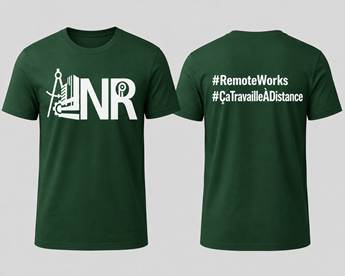
By the time this letter reaches your inbox, we’ll all be on our way back to the office four days per week. The position of the union has continually been one of presence with a purpose. Sadly, this messaging has been continually ignored. And now many members will be forced back to an office that is actually no longer capable of accommodating them in a manner that was accepted as the norm pre-pandemic. A legal challenge has been launched as the employer is not supposed to change the conditions of employment during bargaining and some groups are currently engaged in bargaining. Other actions that you can take are to sign the petition calling for federally regulated workplaces to have a remote provision enshrined in the labour code, send a message to your MP and the president of the Treasury Board, or wear forest green (or just any green) on Wednesdays to promote awareness of the #RemoteWorks campaign. If you don’t have any green, send me an email with your shirt size and address and while I have stock, I’ll send you one of the t-shirts pictured below.
If there are any other actions that you would like to see us take as a union to combat the needless return to office, don’t hesitate to share them with me and I’ll pass them along to the executive and the bargaining team in order to try and implement them.
Upcoming Democratic Deadlines
Two important democratic group deadlines are fast approaching. You should have received emails about both, but I’ll use this opportunity while I have your attention to remind you about them one last time.
If you’re at all interested in participating in your union’s democratic process, the Annual General Meeting for both the NR group and PIPSC as a whole are opportunities to debate and vote on the various bylaws that govern how our union functions. Our group AGM will take place in Ottawa on September 12th, and the PIPSC AGM will take place in Ottawa November 27-28. The deadline to submit your name to participate as a delegate is July 8th.
The other upcoming democratic process is the call for elections for the group executive. If you are a member within the Atlantic, Québec, BC-Yukon or NCR regions and believe you can make a positive contribution to the union, don’t hesitate to stand for election. The deadline to enter your name is July 16th.
Participation in both of these processes is often quite low which I believe is damaging to the union as a whole. A democracy functions best with an engaged and diverse set of participants so please if you’re even considering either of the opportunities don’t hesitate to put forth your name.
New Stewards
Since our previous newsletter, we’ve had a couple new members decide to undertake the responsibility of becoming stewards within our union.
- Darragh Walsh
- Matthew Tong
Stewards play an important role in the functioning of the union. Their role is multifaceted and supports many of the union’s activities. They are the first contact with the union for members and in large part that first interaction shapes member’s opinion of the union. If ever you’re interested in becoming more involved in your union, becoming a steward is one of the best places to start. Becoming a Steward
Meet Your Bargaining Team
Due to missing last month you’ll get to hear from two members of the bargaining team this time. First up is Jamie GoodMurphy, member of the executive and working at DND.

What made you want to join the bargaining team?
I wanted to join the bargaining team because NR members do highly specialized work that is essential to the public service, but that work is not always well understood outside our professions. Bargaining is one of the places where we can take members’ day-to-day realities, translate them into clear proposals, and help make sure the collective agreement reflects the work people are actually doing, not just the tidy version that fits neatly on paper.
What unique insight or skill do you hope to bring to the table?
I hope to bring a systems-thinking perspective shaped by engineering, naval platform work, stewarding experience, and the realities of bringing complex public service capabilities into operation. Much of my day-to-day work sits at the intersection of technical risk, operational need, policy, and contracts. Through stewarding and serving as DND/NCR NR Sub-Group President, I also hear from members across a range of disciplines and workplaces. That background has made me attentive to issues like contracting out, accountability, knowledge retention, workload, professional development, and the long-term value of maintaining strong in-house public service expertise. It has also made me comfortable working through ambiguity, separating evidence from noise, and translating practical workplace issues into clear, defensible positions.
How best do you think the membership can support bargaining?
The best thing members can do is stay engaged and provide concrete examples when asked. Bargaining is strongest when it is backed by clear member input: survey responses, workplace examples, participation in union updates, and conversations with colleagues all help the team show that proposals reflect real and shared concerns across the group. A well-documented example is often worth more than a strongly held suspicion, no matter how correct the suspicion may be.
Our second bargaining team member this month is Phillipe Ouimet from the Canadian Space Agency.

What made you want to join the bargaining team?
In the last rounds of bargaining, there wasn’t a call for candidates open to all members, and that was one of the issues I raised with the members of the executive over the past few years. Given the opportunity offered for the current round of bargaining, I decided to put my name forward. I’ve always enjoyed understanding how processes work and taking part in them is even better. I hope to help improve our colleagues’ working conditions and ensure that their concerns are heard.
What unique insight or skill do you hope to bring to the table?
As a union steward at the Canadian Space Agency for the past 15 years, I have had the opportunity to witness the evolution of the issues affecting members within my organization. The Canadian Space Agency employs a significant number of engineers, and I believe it is important that their experiences and perspectives are represented at the bargaining table alongside those of employees from other departments. We all have something valuable to contribute, and I hope that together we can improve working conditions for all members.
How best do you think the membership can support bargaining?
By participating in surveys, information sessions, and mobilization activities. It is important for members to demonstrate their support for the bargaining team by taking part in these activities and events, because the employer takes notice. When participation is high, it sends a clear message to the employer: “This matters to us, and we want these issues addressed now.” That strengthens our position at the bargaining table. The bargaining team is made up of intelligent and dedicated individuals, but without the support of the membership, we do not have the same bargaining power.
Signing Off
Work in the public service is always going to be continually evolving. As professionals I think we’re all understanding of the need to change and continually learn and adapt as time goes on. That being said, public service employee surveys suggest many are losing faith in the capabilities and decisions being taken by public service leadership. We are currently being faced with some challenges that may seem outside any one person’s control, WFA, RTO, AI, etc. And as a collective we may not always be able to arrive at a perfect solution, but I believe we can work towards arriving at a better one.
In Solidarity,
Nathaniel Cziranka-Crooks
nczicro@gmail.com