Opinion by Sean O’Reilly originally published in The Hill Times on November 4, 2026.
Apparently, the secret to building a stronger Canadian economy is putting environmental scientists on a stopwatch.
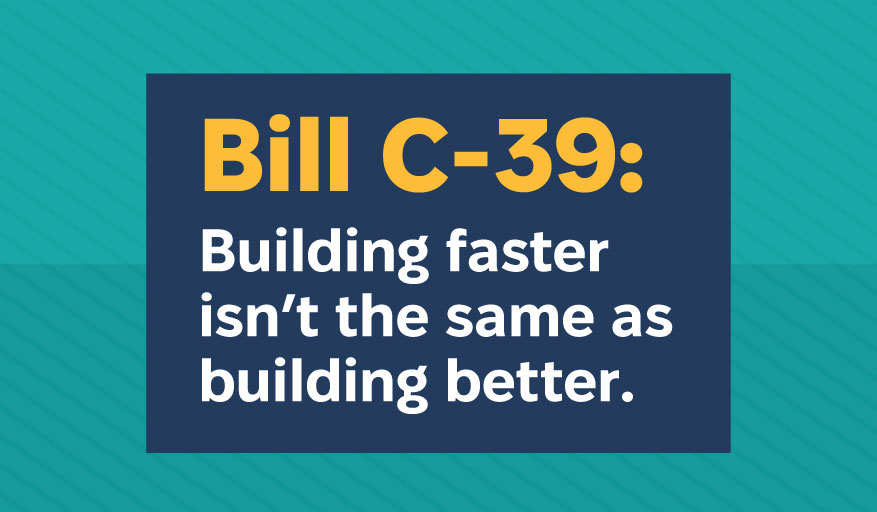
That’s the logic behind Bill C-39 legislation, the Building Canada Strong Act, that proposes to compress federal impact assessments and decisions into a single year, and give cabinet extraordinary powers to clear the way for shovels in the ground—whether the science is ready or not.
But the reality is that environmental risks don’t conveniently disappear when a government deadline arrives.
C-39 treats environmental reviews as bureaucratic hurdles rather than tools for identifying risks before they become costly mistakes.
Making impact assessments more efficient is one thing. Expecting scientists to deliver answers on a political deadline, regardless of what the evidence demands, is quite another.
What happens when scientists uncover flawed studies, unexpected risks to endangered species, or gaps in a company’s evidence that require further investigation? These aren’t bureaucratic obstacles. They’re precisely the questions environmental assessments are designed to uncover.
Some projects can be assessed quickly. Others involve complex ecosystems, cumulative impacts, or scientific uncertainties that take longer to investigate.
The proposed one-year clock would begin once a proponent submits the required information and studies. But receiving an application doesn’t guarantee the evidence is complete, accurate, or sufficient to resolve every risk.
Under C-39, only proponents and cabinet can extend or suspend these timelines. But scientists and independent review panels must also have the authority to ensure timelines allow them to follow the evidence wherever it leads, even when that means exceeding the government’s deadline.
There’s also a fundamental misconception behind the rush to accelerate approvals: that environmental reviews are what keep projects from getting built.
Major projects take years to design, finance, engineer, and construct. Supply chains, labour shortages, and construction challenges also affect timelines. Yet, public debate often casts environmental assessment as the scapegoat for delays.
There’s a reason we say measure twice, cut once. Getting the science right upfront can prevent costly redesigns, legal challenges, environmental damage, and delays. Rushing an approval might save time on paper, only to create bigger problems later.
There’s plenty of enthusiasm for the days when Canada could build a transcontinental railway in a matter of years. Less enthusiasm, apparently, for remembering the thousands of workers who died, the severe exploitation of Chinese labourers, and the Indigenous communities bulldozed along the way.
Speed alone is a poor measure of progress. History shows how costly cutting corners can be.
In 2010, the Deepwater Horizon oil rig exploded in the Gulf of Mexico, killing 11 workers. For 87 days, oil poured into the ocean, devastating marine ecosystems and coastal communities.
The disaster was preventable. Investigators identified systemic failures in risk management and regulatory oversight, including decisions that saved companies time and money. Fisheries shut down, tourism collapsed, livelihoods vanished, and billions of dollars evaporated from local economies.
An effort to save time and “cut red tape” ended up costing tens of billions of dollars, with damage money could never fully repair.
That’s the economic argument for strong environmental safeguards: the cost of getting decisions wrong can vastly exceed the cost of getting them right in the first place.
It’s also why another proposed change in Bill C-39 deserves scrutiny. The legislation would require decision-makers to consider the technical, economic, and practical feasibility of environmental conditions imposed on projects.
Feasibility matters when designing workable protections. But what happens when scientists determine that protecting an endangered species or preventing contamination requires measures a company considers too expensive? How will the government weigh a cost a company considers too high against environmental harm? Bill C-39 doesn’t explain.
Protecting the environment and the science that informs decisions aren’t obstacles to a strong economy. They’re part of what makes one possible: a strong economy is built on evidence.
These concerns are especially significant as the federal government reduces the scientific workforce responsible for environmental expertise and oversight. It’s demanding faster reviews while cutting the expertise needed to conduct them responsibly.
Canada can build faster without sacrificing scientific rigour. That requires resources and a regulatory system that gives independent experts the time and authority to do their jobs.
Parliament should ensure timelines cannot force assessments to conclude before necessary scientific work is complete, and that economic considerations cannot override essential environmental safeguards.
Because the real measure of success isn’t how quickly a project gets approved, it’s whether we got the decision right.
Sean O’Reilly is president of the Professional Institute of the Public Service of Canada.
The Hill Times