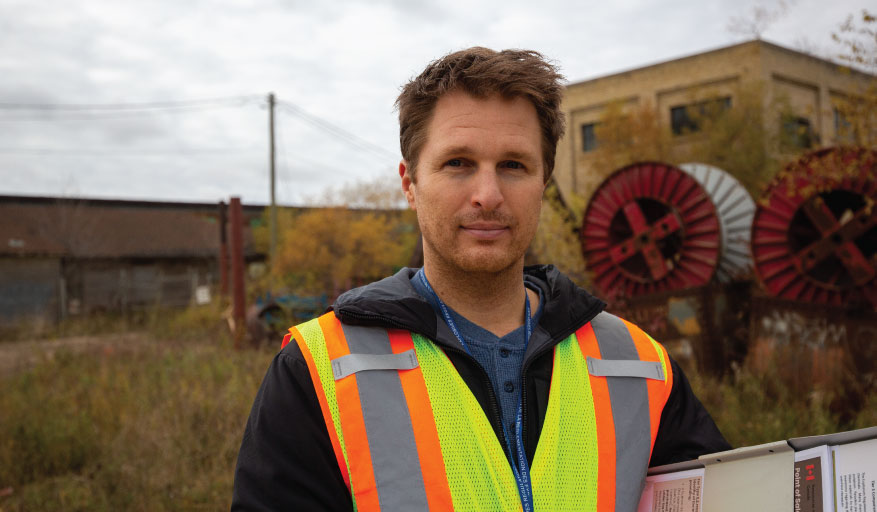
Brendan Olynik is an explosives inspector with Natural Resources Canada (NRCan) in Winnipeg, Manitoba.
He works in the Restricted Components Program, which oversees the public safety of explosive precursor chemicals (substances that can be used to manufacture explosives).
“Our program is really there to minimize the risk of any public safety incident in Canada from occurring,” Brendan says.
Precursor chemicals have legitimate uses. For example, ammonium nitrate is used as a fertilizer in agriculture. High-concentration hydrogen peroxide is used as a disinfectant in various industries, such as water treatment.
“But if they fall into the wrong hands, unfortunately, they can be used for criminal or potentially terrorism purposes as well,” says Brendan, who helps businesses comply with safety regulations for the proper storage and sale of these chemicals.
“I visit quite a diversity of different types of businesses all across Canada. This could include retail stores, distributors, manufacturers, and so it’s really a great experience to meet people from all walks of life across Canada in different types of industries,” he says.
Before joining NRCan in 2019, Brendan worked as a DNA analyst in forensic laboratories in Ottawa and Edmonton. He’s grateful to have landed in a field where he can apply his degree in biochemistry and his passion for traveling and meeting people.
“It is so valuable to be in person and visit businesses, shake hands with staff,” he says.
Making that human connection is crucial in his line of work, where owners may be uneasy about inspections.
“We want to make sure that businesses feel comfortable reporting any incidents to us if anything does come up, because we are really there to raise awareness.”
Global events have underscored the importance of national chemical security. The 2020 explosion in Beirut, Lebanon, that killed hundreds and injured thousands, involved large amounts of improperly stored ammonium nitrate.
While Brendan knows what to look out for, he says chemical public safety is a constantly evolving field.
“There’s examples of explosive recipes or methods that people have used or new methods that perhaps criminals have used that we want to make sure we stay on top of,” he says. “It’s always like a cat and mouse game in some regards where there might be new recipes or technologies to do harm.”
His department is in constant communication with other public safety agencies across Canada that collect data on chemical security events and explosive incidents.
Brendan is also an active PIPSC member and has served as a steward for 4 years. He says being part of the union is rewarding because it’s allowed him to better understand the collective agreement and help others.
“I encourage everyone to participate in one form or another, with their union because it does have so many aspects that affect the job itself, the career, and really, a member’s life altogether,” Brendan says. “And I think the union becomes stronger when there’s more involvement of its members.”
He believes now is an important time for workers to show solidarity in the face of government cuts.
“I don’t think most people realize how many public services are provided on a routine basis,” Brendan says. “Sometimes you don’t notice until you lose services.”
For now, Brendan is optimistic about Canada’s future and the role unions will continue to play.
“I think in Canada, like anywhere else, there’s always going to be curve balls thrown, whether it comes to local or national or global politics, different economic situations,” he says.
“When you have a strong union, when you have strong members that are looking out for one another, I think it does help pave a better pathway to the future for members and professionals.”